

Thank you to Sarah Hursthouse of Dogskool for this interesting blog post.
Is your dog quietly solving problems all day?
Dogs are far more intelligent than many people realise.
Not just obedient. Not just trainable. But thoughtful, adaptive problem solvers who are constantly analysing the world around them.
After more than 25 years working as a Canine Behaviourist, one of the most fascinating things I observe is not how dogs follow cues. It is how they figure things out when no one is guiding them. Understanding your dog’s problem-solving ability can transform the way you live, train, and connect with them.
What Problem Solving Really Means in Dogs
Problem-solving is the ability to achieve a goal when the path is not immediately obvious. For dogs, that might mean:
• Working out how to access food inside a puzzle toy
• Navigating around a barrier to reach their owner
• Figuring out how to open a door
• Learning which behaviours get attention and which do not
This is not random trial and error. It involves memory, attention, emotional regulation, persistence, and sometimes social intelligence. And yes, social intelligence is a huge part of it.
The Social Genius of Dogs
Unlike wolves, domestic dogs evolved alongside humans. Over thousands of years, they became exceptionally skilled at reading us.
Research has consistently shown that dogs are highly responsive to human gestures such as pointing and gaze direction. In fact, dogs often outperform primates in following human social cues.
This is one of the reasons breeds like the Border Collie and Labrador Retriever excel in cooperative work. They are not just energetic or food-motivated. They are attuned to subtle human communication.
From a behavioural perspective, this tells us something powerful. When a dog looks to you during a challenge, that is not dependence. It is sophisticated social problem-solving.
They are asking, “Are we doing this together?”
Independent Thinkers vs Social Problem Solvers
Not all dogs approach challenges the same way.
Some dogs persist independently. Terriers, for example, were bred to work away from human guidance. They tend to keep trying physical solutions.
Others quickly seek human input. Many gundogs and pastoral breeds will pause and look back at their owner when stuck.
Neither style is better. They are simply different cognitive strategies shaped by genetics and reinforcement history.
I have worked with dogs who will dismantle a food puzzle in seconds and others who will sit, stare at it, and then stare at their owner as if requesting technical support. Both are problem-solving. The route just differs.
Emotion and Intelligence Are Linked
Here is something many people miss.
A dog’s emotional state directly affects their ability to solve problems.
A relaxed, confident dog will explore. They will try different strategies. They will persist longer.
A stressed or anxious dog will struggle to think flexibly. Cortisol impacts cognition. Fear narrows behavioural options. This is why punishment based training often reduces creative thinking.
If a dog is worried about making a mistake, they are less likely to experiment.
From a behavioural standpoint, this is critical. When we prioritise emotional safety, we do not just create happier dogs. We create smarter learners.
Memory and Learning Patterns
Dogs are excellent associative learners. They quickly connect actions with consequences.
For example, if pawing at the cupboard once resulted in food, that behaviour may be repeated. If jumping up results in attention, that too becomes a learned solution.
What fascinates me most is how quickly dogs detect patterns.
They know the sound of the treat drawer.
They know the difference between work shoes and walking shoes.
They know when you pick up keys but do not put on a coat.
These are micro problem solving moments. They are constantly predicting outcomes based on environmental cues.
The Power of Enrichment
One of the best ways to support your dog’s cognitive development is through appropriate enrichment.
Food puzzles, scent work, scatter feeding, and problem based games activate natural seeking systems in the brain. They satisfy the desire to work for a reward.
Consider how a breed such as the German Shepherd was developed for complex tasks requiring discrimination, tracking, and decision-making. When these cognitive needs are ignored, frustration behaviours often appear.
Mental stimulation is not a luxury. It is a biological requirement. Even five minutes of problem-solving can be more tiring than a long walk.
What Owners Often Misinterpret
Many behaviours labelled as stubbornness are actually problem-solving attempts.
• A dog pulling on lead may be attempting to reach a desired outcome faster • A dog barking may be experimenting with what triggers attention
• A dog stealing items may have learned it initiates a chase game
When you shift your perspective from “defiance” to “strategy,” your approach changes. Instead of suppressing behaviour, you can guide it.
Encouraging Healthy Problem Solving
Here are a few practical suggestions you can share with clients or try yourself:
1. Allow safe experimentation. Not every challenge needs immediate intervention.
2. Reward persistence, not just success.
3. Keep arousal levels balanced. Calm brains learn better.
4. Rotate enrichment to maintain novelty. 5. Avoid overhelping. Struggle is part of learning.
The goal is not to create a dog who always looks to you for answers. It is to build one who feels confident exploring solutions.
A Final Thought
When you watch a dog pause, tilt their head, assess a situation, and try something new, you are witnessing cognition in action. Problem-solving is not about tricks or obedience titles. It is about adaptability. It is about resilience. It is about a brain that has evolved in partnership with us. The more we understand how dogs think, the more respectfully we can live alongside them. And after 25 years of observing thousands of dogs, I can confidently say this. When given the opportunity, dogs will surprise you with just how capable they truly are.
Any dog behaviour questions anytime, please ask.
Sarah Hursthouse of Dogskool

If you enjoyed this blog, why not treat your dog to an enrichment bundle?
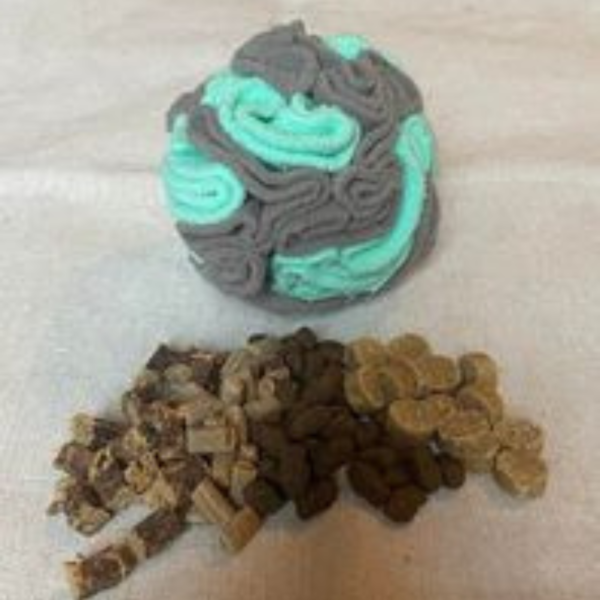
Boredom Buster Enrichment Bundle
Boredom Buster Dog Enrichment Bundle comes with our favourite dog treats, and then choose a fab snuffle ball, fillable enrichment snake, or a kong extreme.